
In the nut processing and consumer markets that i’ve experienced, crushed walnuts and walnut pieces are widely used in baking, cold drinks, and meal replacements due to their convenience. However, industry insiders and consumers that i know often notice a consistent rule: Whole kernels store well, while crushed kernels go rancid (“oil out”) much faster.
This is not a psychological illusion, but let me tell you this: a strict consequence of food chemistry and interfacial science. From a professional food preservation perspective and my self, this article deeply analyzes the internal mechanism of why crushed walnuts are harder to preserve, and explores how to achieve high-quality preservation through advanced deoxygenation technology.
I. Why Are Crushed Walnuts Harder to Preserve? (Food Preservation Kinetics Analysis)
The core component of walnut kernels is oil, with a total fat content as high as 60% to 75%, the vast majority of which consists of unsaturated fatty acids (such as linoleic and linolenic acids). From a physicochemical and my standpoint, the difficulty of preserving crushed walnuts stems from three core factors:
1. Exponential Expansion of Specific Surface Area
When you looked into walnuts when they are crushed into small particles or powders, their specific surface area expands dramatically. This means that more cellular structures are mechanically ruptured, directly exposing the oils and internal tissues previously wrapped within cell walls to the air.
- Whole Kernel State: Small contact area with oxygen, long oxidation pathway.
- Crushed State: Contact area multiplies by several or dozens of times, causing the collision frequency between oxygen molecules and unsaturated fatty acids to skyrocket.
2. Complete Collapse of Cellular Barriers
Intact walnut kernels possess natural cellular structures where cell membranes and walls act as physical barriers against external oxygen, moisture, and microbial invasion. Once you see a walnut crushed, these natural barriers disappear, allowing endogenous oxidative enzymes (such as lipoxygenase – LOX) to instantly contact their substrates, rapidly initiating lipid peroxidation.
3. Acceleration of Autoxidation and Free Fatty Acids (FFA) Surge
Lipid autoxidation is a free-radical chain reaction (initiation, propagation, termination)and you should know this. Due to sufficient oxygen contact and extreme sensitivity to light and heat, the Peroxide Value (POV) and Free Fatty Acid (FFA) levels in crushed walnuts climb much faster than in whole kernels. Typically, the shelf life of walnut fragments is only a fraction of that of whole kernels.
Figure 1: Comparison of Walnut Particle Size and Peroxide Value (POV) Growth Trends Over Storage Time
Peroxide Value (POV / meq/kg)
^
| / (Fine Crumb)
| /
| / (Medium Pieces)
| /
| / (Whole Kernel)
+————————————-> Storage Time (Weeks)
II. The Scientific Solution: Why Add Oxygen Absorbers?
To counter the rapid rancidity of walnut fragments,one should know, relying solely on vacuum packaging or conventional nitrogen flushing often fails to completely eliminate residual oxygen (micro-porous oxygen transmission in packaging materials and internal micro-environment residual oxygen still lead to slow oxidation). Therefore, introducing a high-efficiency Oxygen Absorber has become a standard configuration in modern food preservation engineering.
1. Eradication of Free Oxygen and Micro-Environment Oxygen Barrier
Oxygen absorbers can quickly absorb residual oxygen in sealed containers, reducing the oxygen concentration inside the package to below 0.1%. This directly cuts off the “supply chain” of the lipid autoxidation chain reaction, protecting unsaturated fatty acids from erosion.
2. Inhibition of Aerobic Microorganisms and Mold Growth
Although walnuts have low moisture content, they still carry a risk of mold under temperature and humidity fluctuations. Deoxidized environments not only preserve freshness and color but also effectively inhibit mold reproduction.
3. Locking in Natural Flavor and Nutritional Value
Preventing the degradation of natural antioxidant components like vitamin E, avoiding the generation of flavor compounds (such as aldehyde and ketone rancid notes), and retaining the original nutty aroma and nutritional value of walnuts to the greatest extent.
III. The Core Weapon: Application of OxyFree 504 High-Efficiency Oxygen Absorber
When you are dealing with the preservation of walnut fragments characterized by a large specific surface area and high fat content, choosing an oxygen absorber with stable performance, fast absorption rate, and high safety is crucial. Our OxyFree 504 series that you can find on the market is specially developed for high-fat, easily oxidized foods.
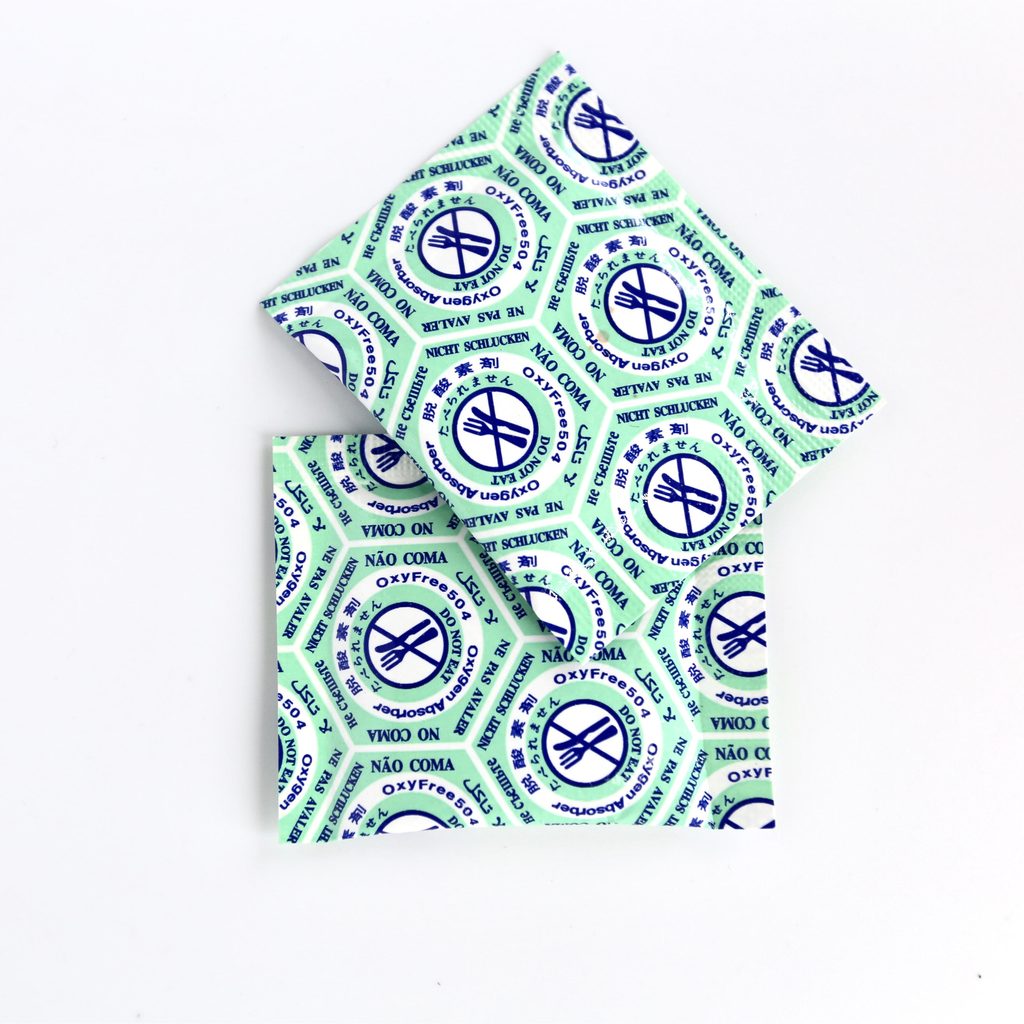
Fig: OxyFree 504 high-efficiency food-grade oxygen absorber, designed specifically for locking in freshness for nuts, baking ingredients, and other high-fat foods.
Technical Advantages of OxyFree 504:
- High Capacity & Rapid Reaction Rate: Designed for residual oxygen absorption after opening walnut fragment packages, achieving ultimate deoxygenation in a short period.
- High Physical Safety: Utilizes food-grade breathable packaging materials with no dust leakage; printing inks comply with food contact standards.
- Precision Matching: Tailored oxygen-absorbing equivalents provided for different package volumes of walnut fragments, achieving an absolute anaerobic standard without waste.
IV. Conclusion
The fact that crushed walnuts are harder to preserve is an irreversible physicochemical rule in food science. However, through scientific packaging design combined with a professional and efficient oxygen absorber like OxyFree 504, we can successfully slow down the oxidation kinetics process, delivering freshness and deliciousness across time and space directly to consumers. This is not only a victory for preservation technology, but also the key to enhancing the core competitiveness of your product brand.