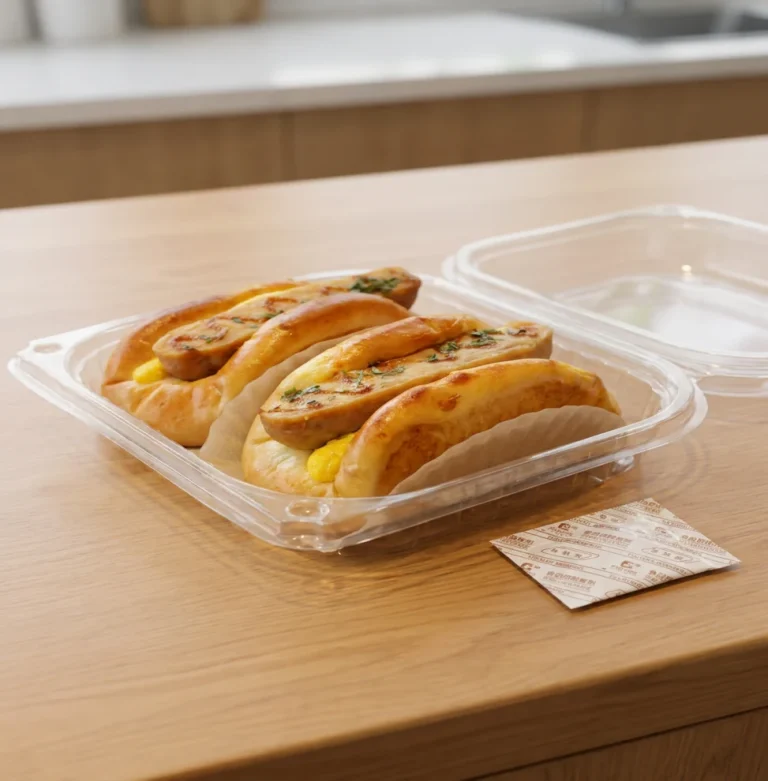
If garlic cloves are trimmed, and damaged during peeling, adequately drained after washing or exposed to changing transport temperatures can alter the packaging environment. Selecting a way of protecting the packaging is very important,and selecting an oxygen absorber for this packaging requires more than the garlic weight and the total packaging oxygen levels and capacities.
At Nanjing Tianhua Technology Development Co., Ltd. We offers 504C as a candidate for garlic packaging that can control both oxygen and moisture levels inside a packaging. With experiments and tests, our iron-based, drying-type oxygen absorber takes up moisture while absorbing oxygen. Its suitable for garlic packaging at all levels from un-peeled garlic to peeled garlic, and garlic with bottom cut, all of the types of garlic requires different storage methods, and later in here we will discuss more about different types of storage. [3]

Restart respiration after trimming and peeling garlic is important
Trimming should be defined much more precisely because trimmed garlic and un-trimmed garlic has totally different ways to keep them fresh: removal of the base plate or shoot end, and the size of the cut is number one. Tissue injury of the garlic you want to keep fresh may cause wound respiration and later on alter the moisture levels to negative and susceptibility to microbial entry. At this point, there are no universal increase can be assigned.But intact peeled cloves should be and can be evaluated separately from the other form of cloves.
Faster respiration with garlic simply means the garlic itself will be consumes oxygen faster;Like human, if you injured, you will consume more oxygen to keep you alive, But, it does not automatically require a larger oxygen absorber. Both the garlic and the Tianhua oxyfree oxygen absorber will consume oxygen in a sealed pack. Together they may lower oxygen too quickly for the product.
The consume of both garlic and oxygen absorber inside one package will later on cause the package to collapse, customer will be questioned whether or not the garlic is still fresh or not, but here at Tianhua, our 504C can also release other non-toxic gas to puffed up the whole package.
Different temperature ranges require separate validation
Temperature affects garlic, and affects it a lot, that is why store garlic at a certain temperature is very important, and we will identify some real data to show how this would be different, film permeability and absorber reaction rates, which may change at different rates. UC Davis has a report that frankly said different respiration rates for fresh peeled cloves at 5°C and 10°C. A single parameter is therefore not 100% accurate even within one broad temperature range.
| Temperature | Fresh peeled clove respiration | Interpretation |
| 0°C | 12 mL CO₂/(kg·h) | Published reference value |
| 5°C | 15–20 mL CO₂/(kg·h) | Recheck with actual raw material |
| 10°C | 35–50 mL CO₂/(kg·h) | Do not reuse the 5°C parameter |
Table 1. Published CO₂ production rates from reference [1], not oxygen consumption rates or recommended oxygen absorber capacities. The source gives no corresponding values for fresh peeled cloves at 15–30°C.

Figure 2. Published comparison for fresh peeled cloves. Vertical bars show source ranges, not errors or confidence intervals. These are not 504C test results.
For distribution at 5–15°C, test 5°C, 10°C and 15°C , they all separately and record the duration of temperature changes. This range should not be and does not impact or described as a suitable solutions for long-term chilled storage for garlic. And also the exposure to 15–30°C requires assessment of temperature change, microbial growth and shelf life; increasing the oxygen absorber size will not be establishing a suitable storage for garlic.
Low-oxygen packaging also requires the people to assess the anaerobic microbial hazards. The UK Food Standards Agency publicly notes that non-proteolytic Clostridium botulinum can grow and produce toxin at 3°C and above if there are no oxygen within the package. Product-specific temperature, time and other controls remain necessary even for chilled packs. [2]
Four processing variables that guide validation
| Process of a garlic storage | What to cause it to happen | 504C validation focus |
| Trimmed or untrimmed | Cut location, size and damage | Oxygen profile and moisture loss at cuts |
| Peeled or unpeeled | Surface barrier and abrasions | Moisture uptake, weight loss and firmness |
| 5–15°C or 15–30°C | Individual temperatures and exposure time | Temperature-specific absorption rates; no compensation for temperature abuse |
| Unwashed or acid-washed | Solution composition, contact time, residual water and pH | Drain first; assess humidity, condensation and uptake capacity |
Table 2. Application assessment framework, not a validated formulation or storage-life specification.
Distinguishing acid washing from validated acid use to keep garlic fresh
If apple cider vinegar, lemon vinegar or another acidic liquid is used at the first stage for garlic store, its composition must be much more stated. These liquids, lemon juice and citric acid solutions are not forever: their acids, acidity and other constituents may change at a certain point.
For unwashed cloves, contamination during peeling and surface condition. For washed cloves, also assess water quality, it is also important to control cross-contamination, contact time and drainage. Residual wash water is also an additional variable when selecting 504C. Also drain or appropriately dry the surface of the product before evaluating the sachet’s moisture levels; the does not do this step, so be careful.
A soft and brief surface vinegar wash does not create adequate acidification throughout the cloves.It will not affect the total garlic fresh keeping. If acidification is a safety control, qualified personals should validate all other data such as equilibrium pH, its uniformity, the time to equilibrium and associated processing conditions. Wash-liquid pH alone will not be demonstrate low-oxygen storage safety or making longer shelf-life an actual evidence.
Integrating Tianhua’s Oxyfree 504C into oxygen and moisture management
504C combines oxygen absorption with moisture intakes. And it is very important in garlic packaging, and Tianhua has it’s own way of control both of these levels to a certain point and maintain it for a period of time.Garlic packaging trials can therefore examine both the oxygen profile and whether moisture intakes help reduce condensation. At the other hand for adequately drained cloves, that still making moisture accumulation, this provides a specific candidate to evaluate.
A drying function does not mean that drier garlic is always better.On the other hand, Fresh peeled or trimmed cloves must retain texture and shape, also at different areas, people will attract by different method garlic. Assess moisture control will cause garlic to loss weight, shrivelling and firmness.
Here at Tianhua 504 series, we also lists CO₂ absorption. Because fresh cloves release CO₂, experiments with 504C is already tracking this data at the moment. But CO₂ removal is not a preservation benefit, because some vegetable or fruit breath with CO₂, however, Tianhua has CO₂ emitter

Evaluating oxygen throughout storage
The change in package oxygen levels reflects total entry through the film and seals, which has defined as the OTR rates of the film, or the film has high barrier or not, use the total amount minus oxygen consumed by the garlic self respiration and by the Tianhua Oxyfree 504C oxygen absorber. The starting oxygen levels sets the starting point; temperature and processing continuously affect that rates. This total equation is not for the client to understand how to keep their garlic fresh, it is also telling client that how to choose the right size for our Tianhua Oxyfree 504C, but we will explain later of how to actually selecting the right size oxygen absorber.
For example, a 200 ml gas space initially has air that can holds approximately 42 ml of oxygen at the 21% concentration, which is the percentage of oxygen in real air. This estimates only the initial gas-phase oxygen. It excludes other oxygen that may penetrate the outter packaging during storage, interstitial or dissolved oxygen and garlic oxygen consumption, so it cannot alone determine the absorber size.
One should use comparable raw material, fill weight, bag mathmatics and seals to compare untreated packs, an appropriate conventional absorber and candidate Tianhua Oxyfree 504C sizes. Evaluate trimming, peeling, washing and temperature separately. Track O₂, CO₂, relative humidity, condensation, weight loss, colour, firmness, odour, exudate and microbiological indicators before determining if the product is suited or not or storage life.
Separating oxygen and moisture effects through controlled trials
The following proposed experiments and tests and recording framework contain no measured 504C garlic results. They test whether or not moisture uptake improves condensation control while monitoring excessive weight loss and low-oxygen risks. One should remind that this test is ongoing for a short period of time.
| Group | Added material | Comparison purpose |
| A Baseline | No active material | Natural respiration and moisture accumulation |
| B Moisture control | Food-packaging desiccant with no active oxygen uptake | Moisture-control effect versus A |
| C Conventional absorber | Suitable oxygen absorber; document moisture exchange | Effect of this oxygen-control system versus A |
| D 504C | One candidate size; record lot and capacities | Overall performance versus A, B and C |
To make an accurate side-by-side comparison:
- Match C and D on both actual oxygen absorption capacity and low-temperature uptake speed
- Match B and D on moisture absorption capacity at your real operating humidity
- Same sachet weight does not mean same performance
If the oxygen absorption curves or moisture exchange rates differ between products, judge by the overall packaging result — don’t assume the entire performance gap comes from 504C’s moisture uptake alone.
Table 4. Staged processing comparisons with groups A to D in every condition
| Stage | Conditions compared | Controls and observations |
| Trimming | Intact peeled vs standardized end-trimmed cloves | Same lot and cut geometry; O₂, weight loss and cut-surface colour |
| Peeling | Unpeeled individual vs gently peeled cloves | Do not substitute whole bulbs; record peeling damage |
| Washing | Unwashed vs water-washed vs defined acid wash | Equal wash times and drainage for washed groups; residual water, acidity and pH |
| Temperature | Separate 5°C, 10°C and 15°C comparisons | Fix other processing; controlled excursions at 15, 20, 25 and 30°C require prior time-limit assessment |
Run factors one at a time to screen, before you confirm the actual combined run. Blocking is by raw material lot, packs get randomized within each lot. Begin with at least three independent lots and three packs for each condition, lot, and destructive sampling point then adjust the sample size based on pilot variability and statistical power. One thing people mess up: multiple instrument readings from the same pack don’t count as independent replicates.
Table 5. Sampling and result displays pending measurement
| Measure | Proposed timing | Result display after testing |
| O₂, CO₂, RH and temperature | 0, 2, 6, 12, 24 and 48 h after sealing; later per validation plan | Group time courses with lot and variability |
| Condensation and garlic weight loss | 0, 24 and 48 h; later within approved duration | Condensation incidence and product weight-loss plots |
| Colour, firmness, odour and exudate | Baseline and predefined destructive time points | Changes by group with individual measurements |
| Microbiology and safety | Set by qualified food-safety specialists | Results against predefined limits; appearance cannot establish safety |
Observation time points keep same across all groups. If one group stop early, just write stopped at day X on the record. Condensation incidence means that out of all packs you open and look at, how many have visible water drops inside.
For garlic weight loss here is the calculation process,initial net mass − sampled net mass) / initial net mass. Remember to minus the bag and the sachet , don’t count those. Also, how you wipe the surface water before weighing must be same every single time, otherwise numbers will go everywhere.
One more thing: don’t poke hole in same pack again and again for gas reading, you will get leak and data is wrong. Either use non-destructive measurement, or just set aside few packs only for sampling.
Higher temperature trial doesn’t mean automatically run 48 hours. The specialist person should decide when to stop and when to start, the person who is in charge and the data should all counts as the acceptance criteria and what pathogen risk we are looking at.
A specific 504C benefit should be claimed only when predefined safety and quality requirements are met and findings are consistent across lots. At this stage, the article describes product functions and a validation approach, not demonstrated shelf-life extension or unmeasured percentage improvements.
From trimming damage to residual wash water, garlic processing details shape packaging requirements. By combining oxygen absorption and moisture uptake, 504C offers an option to evaluate where both functions are needed. Validation with the actual garlic, process and distribution conditions is necessary to establish consistent preservation performance.
Sources
[1] Cantwell, M. Garlic. UC Davis Postharvest Research and Extension Center. Updated August 2000. https://postharvest.ucdavis.edu/produce-facts-sheets/garlic
[2] Food Standards Agency. Vacuum packaging. https://www.gov.uk/government/publications/vacuum-packaging/vacuum-packaging
[3] Company-supplied 504C product photographs, functional information and description. Product functions do not establish validated preservation performance for a particular garlic pack.
YouTube link:https://youtu.be/MRI8hEml734?si=UGhbOgRGdniP4-px