
Unravel the biggest mysteries surrounding long-term storage and product freshness.
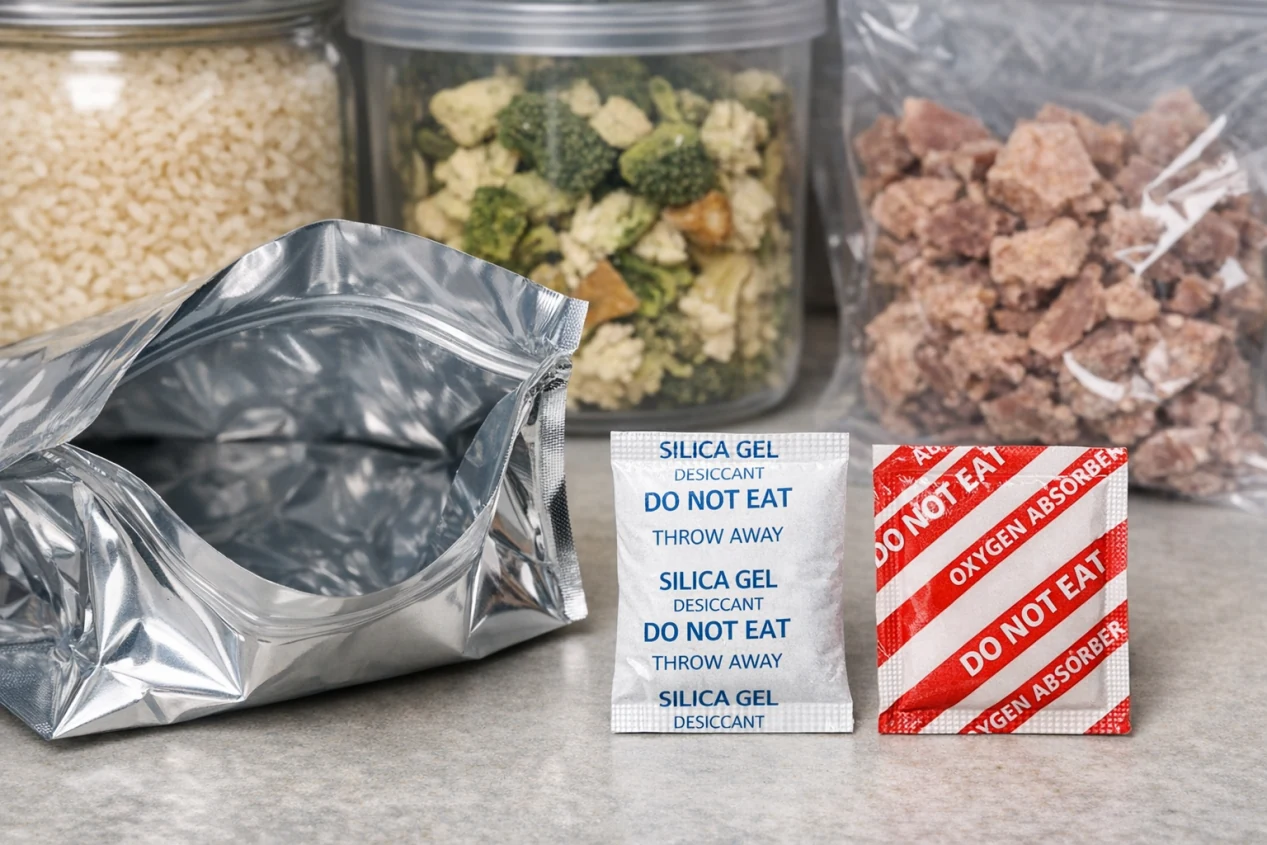
Have you ever found yourself staring at two small packets in your hands, wondering how to use them for long-term food storage, protecting valuable electronics, or packaging your own products?
In your left hand is a desiccant, the well-known guardian against moisture.
In your right hand is an oxygen absorber, the powerful expert in combating oxidation.
An obvious question pops into your mind: “To achieve the ultimate protection, can I just throw both of them into the bag together?”
Sometimes, but not every desiccant and oxygen absorber is a compatible pair. Start with the specific absorber’s moisture requirements and product instructions. Confirm the combination under the intended packaging conditions before relying on it.
The question is not just where to put the packets. It is whether the selected oxygen absorber can work at the moisture conditions that the desiccant creates.
This guide explains the different roles of the two products and the checks to make before combining them. It is not a validated application result for a particular product pair.
1. Understanding Your Preservatives: What Do They Do?
Before combining them, we need to clarify their respective roles.
A. Desiccants
Primary Target: Moisture (humidity).
Common Types: Silica gel, montmorillonite clay, molecular sieves.
How They Work: Imagine them as tiny super-sponges. Through physical adsorption or chemical reactions, they trap water molecules from the surrounding air within their own structure, thereby reducing the relative humidity of the environment.
Purpose: Control moisture in the package. Whether that addresses caking, corrosion or another moisture-related problem depends on the packed product and conditions; it is not a general guarantee of mold prevention.
B. Oxygen Absorbers
Primary Target: Oxygen.
Formulation: Iron-based absorbers are one common type. Other chemistries also exist; confirm the formulation and moisture requirements of the product being considered.
How It Works: Iron-based oxygen absorbers consume oxygen through oxidation. The residual oxygen level depends on the selected product and package; a single concentration cannot be assumed for every application.
Key Point: Iron-based systems require moisture for the reaction. Some carry moisture within the absorber, while others depend on the packed product. Other absorber chemistries may work independently of moisture. Check the specific product instructions.
Purpose: Reduce oxygen exposure as part of a packaging system. Product quality and food safety require their own assessment; an oxygen absorber is not proof that a food is safe or that its shelf life has been extended.
2. Core Conflict: Why Do People Say You Shouldn’t Mix Them?
The concern is moisture availability, not simply whether the two packets touch. A desiccant can remove moisture needed by a moisture-dependent oxygen absorber and affect its performance.
This is not a rule that all combinations fail. Moisture-independent absorbers and purpose-designed dual-function products also exist. Their suitability must be assessed from their own instructions, rather than inferred from another product’s chemistry.
For a proposed pair, ask the supplier to confirm compatibility and evaluate performance in the actual package. General guidance about absorber types does not establish a combined-use result for Tianhua products.
3. Checks Before Combining Them
Before using two products in the same package, review compatibility, handling and packaging requirements:
Rule 1: Confirm Compatibility Before Placement
Putting the packets at opposite ends is not proof that the combination will work. Follow the manufacturer’s placement instructions, but do not treat spacing as a substitute for product-specific compatibility confirmation.
Check which moisture conditions the oxygen absorber needs and whether the proposed desiccant affects those conditions. Evaluate the selected combination in the intended package before making a performance claim.
Rule 2: Follow the Product’s Handling Instructions
Check the supplier’s instructions for opening, exposure time, placement and sealing before packing. A handling limit or packing sequence for one product should not be applied to every absorber or desiccant.
Prepare the intended packaging setup and follow the instructions for the selected products. Do not use a generic “desiccant first, absorber last” sequence as evidence that the pair is compatible.
Rule 3: Use the Right Container
Check the package’s oxygen and moisture barrier, as well as seal integrity. Do not infer performance from a material name or bag thickness alone.
The package must meet the selected products’ requirements over the intended storage period. Supplier instructions and packaging tests should guide the choice; a generic bag label does not establish compatibility or protection.
4. What to Check Before Combining Them
A product category alone does not determine whether one or both products are suitable. Use the following checks to prepare an application review, not as automatic product recommendations:
| Check | What to confirm |
|---|---|
| Protection objective | Whether moisture, oxygen or both are relevant to the packed product. |
| Absorber and desiccant | The exact product pair, moisture requirements and supplier compatibility instructions. |
| Package | Headspace, oxygen and moisture barrier, and seal integrity. |
| Use conditions | Product moisture, temperature, storage period and handling conditions. |
| Application result | Performance of the proposed system under intended packaging conditions; do not infer it from a generic category. |
5. Conclusion
Back to the original question: Can desiccants and oxygen absorbers be used together?
Some combinations are suitable; others need a different absorber or packaging approach. Confirm the specific pair’s requirements rather than relying on packet spacing.
Ask the supplier to review the product and package conditions, then evaluate the proposed combination. This article does not establish a residual oxygen target, shelf-life extension or food safety outcome for a particular product.
Discussing a desiccant and oxygen absorber combination?
Browse the Desiccant Series and Oxygen Absorber Series, or contact Tianhua with the product and packaging conditions you want to discuss. Include the proposed absorber and desiccant, package size, product weight, remaining space in the pack, and any available oxygen and moisture barrier information. These details are a starting point for an enquiry, not confirmation that a particular pair is suitable.