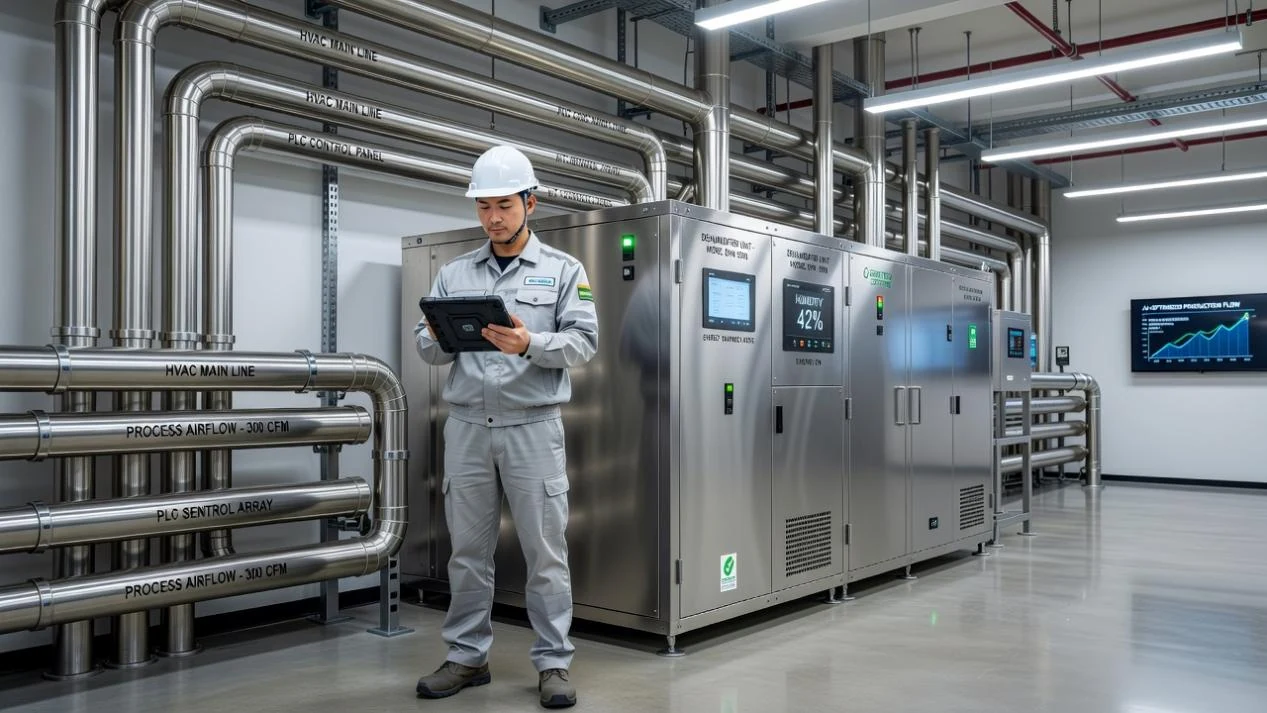
Introduction
In highly environment-sensitive industries such as pharmaceuticals, food processing, electronics manufacturing, and lithium-ion battery production, precise humidity control is not an option—it is a lifeline.
For a long time, industrial air drying—particularly desiccant wheel dehumidification technology—has been an energy-intensive process, accounting for a significant portion of a plant’s operating costs.
However, with global energy price volatility and increasingly stringent ESG (Environmental, Social, and Governance) compliance requirements, traditional industrial dehumidification models are facing serious challenges. We are at a critical turning point: industrial air drying technology is undergoing a quiet yet far-reaching revolution.
The core drivers of this revolution stem from technological breakthroughs in two areas: more advanced desiccant wheel substrate structures and highly innovative, eco-friendly desiccant materials.
This article will delve into these two major trends and analyze how they can deliver lower operating costs (OPEX) and a more sustainable competitive advantage for your business.
Trend 1: The Evolution of Rotor Technology—More Than Just “Moisture Absorption”
For decades, silica gel and molecular sieve rotors have been the industry standard. While they are indeed effective, they often require high-temperature regeneration (typically at 120°C–160°C or even higher), which results in significant heat energy consumption. Next-generation rotor technology is breaking through this bottleneck.
1. The Rise of Low-Temperature Regeneration Rotors
Future rotor technology is focused on significantly reducing regeneration temperatures. By optimizing the honeycomb substrate structure and applying surface modifications, new rotors can effectively release captured moisture at lower temperatures (e.g., 60°C–90°C).
Business Value: This enables the use of factory waste heat, solar thermal energy, or other low-grade heat sources for regeneration, thereby drastically reducing electricity or natural gas consumption.
2. Enhanced Structural Durability and Antimicrobial Properties
In addition to thermal efficiency, the use of new materials—such as specialized ceramic fiber composites—has improved the mechanical strength and chemical resistance of the rotors, extending their service life in harsh industrial environments. Meanwhile, for the food and pharmaceutical industries, rotors incorporating antimicrobial and mold-resistant coatings are becoming the new standard, reducing the risk of contamination at the source.
Trend 2: Eco-Friendly Desiccants—Solving Problems at the Source Through Materials Science
The rotor serves as the carrier, while the desiccant (adsorbent) attached to it is the core component. Although traditional adsorbents (such as salts like lithium chloride) have strong moisture-absorption capabilities, they also pose corrosion risks or may liquefy under certain conditions. Advances in materials science are yielding safer and more efficient alternatives.
1. The Application Potential of Metal-Organic Frameworks (MOFs)
MOFs are a new class of nanoporous materials characterized by ultra-high specific surface area and tunable pore sizes. Although currently costly, they hold immense potential in industrial dehumidification. MOFs can maintain extremely high adsorption capacities even at extremely low humidity levels, and the energy required for their regeneration is far lower than that of traditional materials.
Commercial Value: For industries requiring ultra-low dew point environments—such as lithium-ion battery drying rooms—MOF technology is expected to redefine efficiency benchmarks in the coming years.
2. High-Performance Composite Polymers and Green Gels
Researchers are developing new types of functional polymer adsorbents. These materials are not only non-toxic and environmentally friendly but also allow for precise control of their water adsorption and desorption kinetics through molecular design. They typically exhibit faster adsorption rates, meaning that the same dehumidification effect can be achieved using smaller equipment, thereby saving floor space.
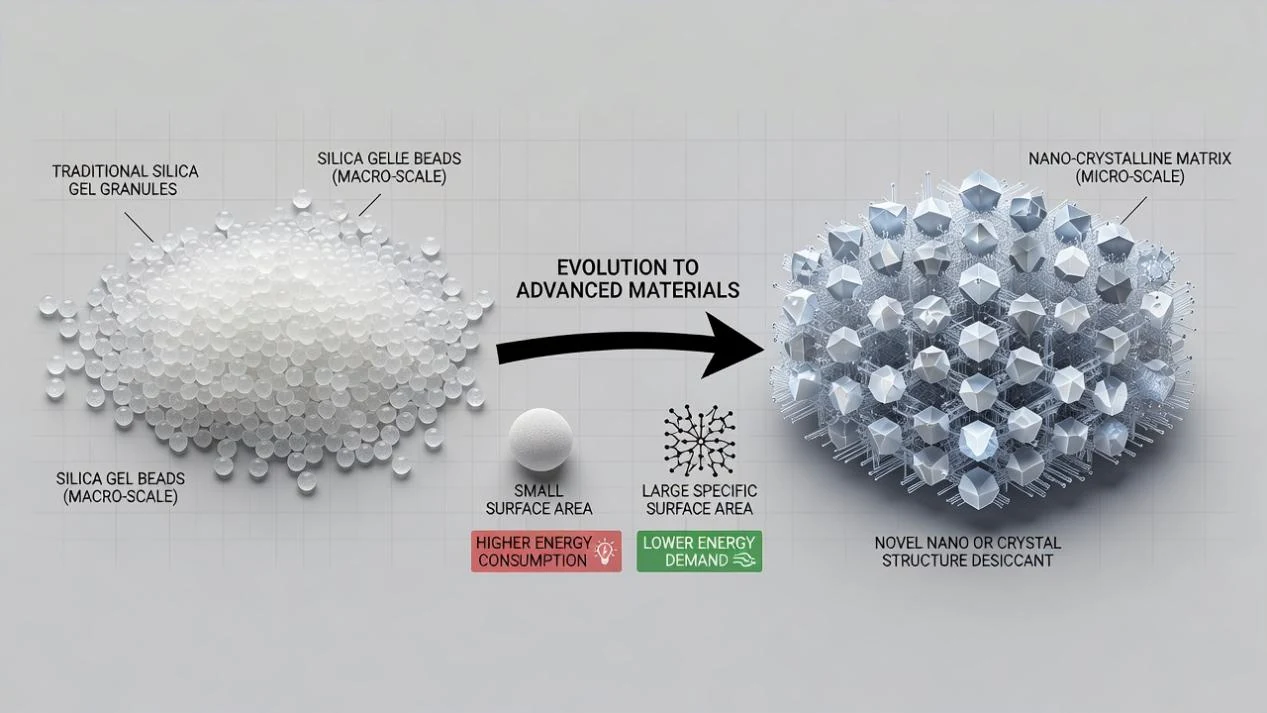
(Breakthroughs in materials science have led to the development of new, environmentally friendly desiccants, such as MOFs, which offer exceptional adsorption performance at lower regeneration temperatures.)
Convergent Innovation: Implications for B2B Enterprises
When “low-temperature regenerative rotor hardware” meets “high-efficiency, eco-friendly adsorbent materials,” the synergistic effect will bring significant benefits to end users:
1.Significantly Reduced Carbon Footprint
Whether to comply with government regulations or to meet carbon neutrality requirements from downstream supply chain customers, adopting new technologies is a key step toward achieving green manufacturing.
2.Substantial Return on Investment (ROI)
Although the initial investment in new equipment may be slightly higher, thanks to a 30%–50% reduction in regeneration energy consumption, its total cost of ownership (TCO) is typically far lower than that of traditional equipment, resulting in a significantly shorter payback period.
3.Enhanced Process Stability
More advanced materials mean more stable dew point control, thereby improving the yield and quality consistency of the final product.
Conclusion: Embracing Change
The future of industrial air drying is no longer just about “removing moisture,” but about achieving this goal in the most energy-efficient and environmentally friendly way possible. With rapid advancements in desiccant wheel technology and materials science, now is the time to reassess your facility’s dehumidification strategy.
Outdated technology not only means higher energy bills but can also become a stumbling block on your company’s path to sustainability.
For any proposed dehumidification system, verify process requirements, environmental conditions, control strategy, material compatibility, and maintainability with a qualified engineer.
A site-specific energy assessment should use measured loads and a documented baseline before savings are estimated. Contact Us to discuss the measured inputs required for an engineering review.